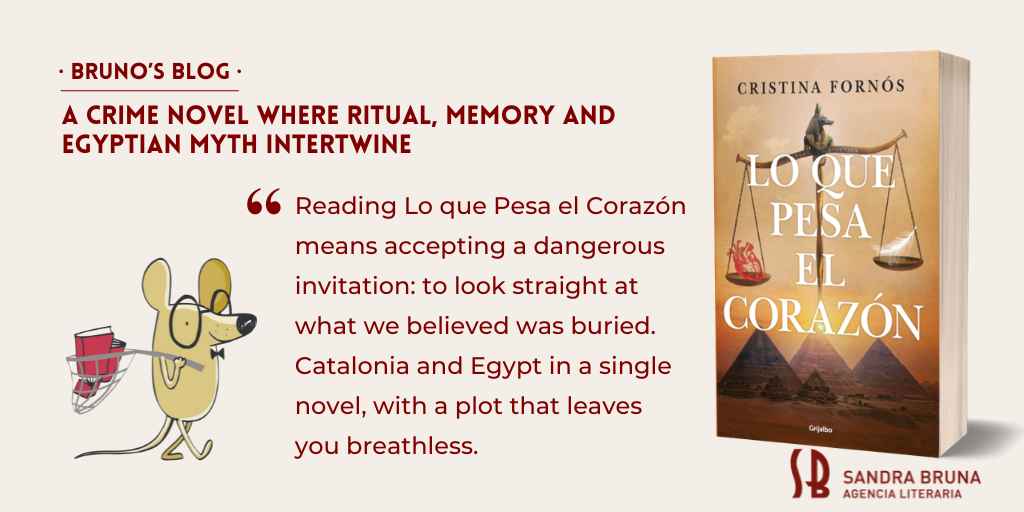
Cristina Fornós joined the agency through one of our leading authors, Miquel Esteve, and with her previous novel, La tierra del silencio roto, she had already left us with more than a lasting impression. So, to those of you who enjoyed that first story, I can only say one thing: get ready for the second.
In this new work, Cristina takes a step further into darkness, yet without setting aside the historical dimension. Instead, she achieves a remarkable blend. The result is a powerful combination: a crime novel with a strong historical backdrop that grips readers from the very first page and broadens its appeal to a wide and diverse audience. Catalonia and Egypt converge in a single story, driven by a plot that barely lets you breathe.
For all editors seeking crime fiction with thriller undertones and a distinctive edge, this is your novel.
Crime erupts in this story like a ritual. It does not seek only to kill; it seeks to explain something. From the very first scene, Heart’s Weight makes it clear that this is not a conventional crime novel, but a story where violence carries memory and the past demands interpretation.
In the riverbed of Cambrils, two bodies appear—each defying any simple reading. A woman wrapped in a sheet, an ostrich feather in her hand, her heart torn out. A dismembered prosecutor inside a suitcase, a mask of the Egyptian god Anubis covering his face. The symbols are not there to decorate the crime; they are there to point toward an origin far older than it seems.
Agents Sagi and Vidal soon find themselves facing an investigation that refuses to move in a straight line. The clues lead them to a nuclear accident that occurred in Vandellós thirty years earlier, an episode buried under layers of silence, guilt, and oblivion. But they also lead toward a figure as fascinating as unsettling: Albert Coma, a nineteenth‑century Egyptologist obsessed with Ancient Egypt and the promise of eternal life.
The arrival of journalist Lara Peña adds a new layer to the narrative. Together with the investigators, she must piece together a puzzle in which Egyptian myth, modern science, and contemporary violence intertwine in disturbing ways. The journey is not only geographical or historical—it is moral. Because the deeper they delve into the origin of the symbols, the clearer it becomes that the beauty of myth can conceal an extreme perversion.
Heart’s Weight builds its tension unhurriedly, relying on a dark, precise atmosphere. Catalonia becomes a stage filled with echoes, where present‑day landscapes converse with ancient beliefs, and where each discovery pushes the reader to look beyond the obvious. There are no concessions to the superficial: everything has a purpose, everything carries weight.
Cristina Fornós’s trajectory is evident on every page. Her experience in journalism brings credibility, rhythm, and a sharp eye for power, institutions, and their secrets. Her background in communication translates into a clear, effective, and deeply visual narrative. And her literary vocation emerges in the ambition of the premise and the care given to the symbolic undercurrent.
This is a novel for readers seeking more than a mystery to solve. For those who enjoy thrillers that unsettle, that force a connection between past and present, and that do not shy away from territories where reason falters and beliefs still demand their place.
Reading Heart’s Weight means accepting a dangerous invitation: to look directly at what we believed was buried. And to discover that sometimes the most terrifying thing is not the crime itself, but everything that sustains it.