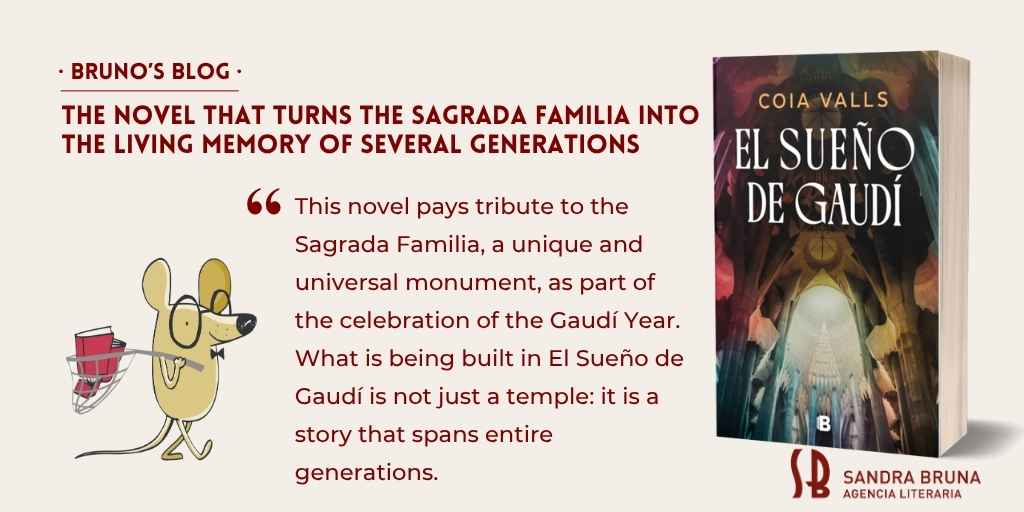
This novel pays tribute to the Sagrada Familia, a unique and universal monument.
Just as we did with La Catedral del Mar (Cathedral of the Sea) by Ildefonso Falcones, now, through the voice of Coia Valls, we give life to another symbol of our city, even more iconic. With this work, we celebrate the Gaudí Year, marked by the completion of its final tower, crowned with a stunning star that is destined to become one of the most spectacular viewpoints in the world.
Next June, during his special visit to Barcelona, the Pope will inaugurate this new architectural milestone that connects past, present, and future.
It all begins with a decision that seems small but ends up shaping everything. In El sueño de Gaudí (Gaudi’s Dream), this initial moment takes place in Barcelona in 1883, when the construction of the Sagrada Familia is little more than a sketch and yet already begins to leave its mark on those who encounter it. What is being built is not just a temple: it is a story that spans entire lifetimes.
The novel offers a journey across five generations bound by that same heartbeat. From Anna and Guillem, witnesses to the earliest stages of the construction, to Anna Maria, the one who keeps the family memory alive, Coia Valls builds a saga in which time does not simply pass, it accumulates. It is not just a historical novel: it is an intimate exploration of how the passage of time transforms people and cities alike.
Each character inherits more than a surname. They inherit silences, decisions, wounds, and also a way of seeing the world. Within this emotional tapestry, the Sagrada Familia ceases to be a mere setting and becomes a constant, almost conscious presence. It breathes, observes, and transforms, as if it were part of the family itself.
Throughout its pages, Barcelona breathes, shifts, and fractures. Epidemics, wars, losses, and rebirths intertwine with the evolution of the temple, creating a mirror between the collective and the intimate. The city is not a backdrop: it is a character that rebuilds itself again and again, just like those who inhabit it.
Coia Valls, with a solid trajectory in historical fiction, once again demonstrates her ability to balance documentation and emotion without losing fluidity. Her prose moves naturally, guiding the reader without imposing itself, and makes more than a century of history feel close. There is rigor, but also a sensitivity that turns every scene into something truly lived.
If you are drawn to novels that combine history, emotion, and legacy, El sueño de Gaudí is a safe bet. It not only invites you to explore Barcelona, it invites you to reflect on what you are building in your own life, both visible and invisible. And when you close the book, you will most likely see the Sagrada Familia with different eyes.