Stories that linger don’t always make a noise. Some arrive quietly, like a seed falling onto freshly turned soil and beginning its work slowly, without asking permission. The Sleeping Garden belongs to that kind of novel—one that isn’t read in haste, but with an almost intimate attentiveness, because it speaks of breakups, of existential fatigue, and of the deep need to begin again when everything seems to have run out of sap.
Iris doesn’t flee. Iris leaves. She leaves behind a relationship that no longer sustains her and a career in banking that never truly felt like her own. There are no grand gestures or epic decisions—just an accumulated weariness that pushes her to look elsewhere. That “elsewhere” appears in the form of a strange, almost poetic job advertisement: someone is looking for a person capable of bringing life back to a forgotten garden in the Empordà. A garden in ruins, a house with a past, and a woman in need of rebuilding herself. Sometimes destiny has a very precise sense of irony.
Iris’s journey to the House of Oblivion is not only physical. There, she is met by paths overgrown with weeds, withered flowers, and silences that carry weight. She is also accompanied by memories of summers with her grandmother, a key figure who connects past and present, memory and wound. A tarot reading, laden with floral symbols, finally pushes her to accept the risk. And it is in that gesture that the novel begins to unfold its full meaning: daring when there are no guarantees is often the first act of self-love.
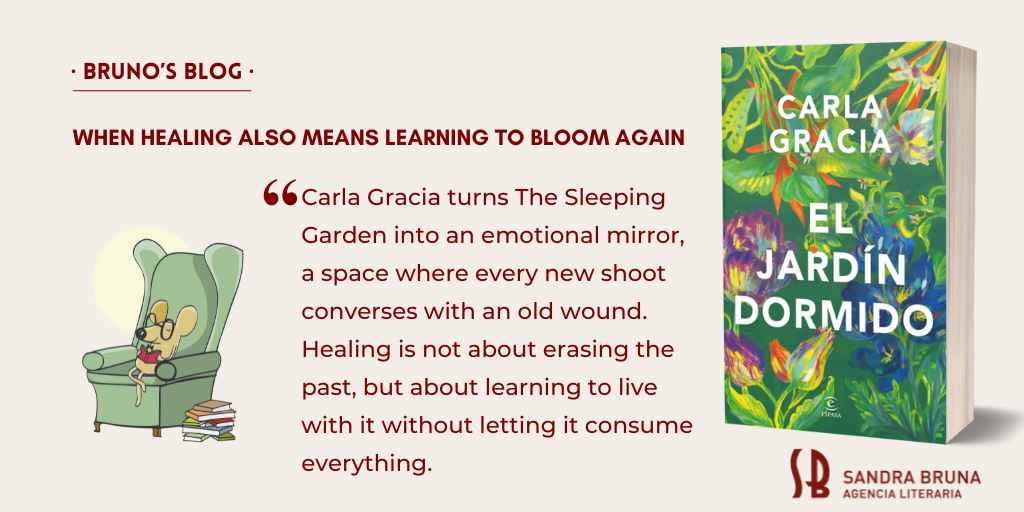
As Iris restores the garden, layer by layer, the story becomes deeply sensorial. The earth under her fingernails, the scent of plants, the slow rhythm of daily care. Carla Gracia turns the garden into an emotional mirror, a space where every new shoot converses with an old wound. Healing is not about erasing the past, but about learning to live with it without letting it consume everything. And that is exactly what happens to the protagonist.
The House of Oblivion not only keeps secrets within its walls; it also hides them in the people who inhabit it. The relationships Iris forms there are not mere narrative companions, but essential pieces of an honest, unsweetened process of transformation. There are no magical solutions or contrived endings. There is time, care, and an attentive listening to what hurts. The novel trusts the emotional intelligence of its readers and does not need to underline its messages.
Part of the strength of The Sleeping Garden lies in its author’s voice. Carla Gracia writes from a place that has been deeply worked through, both literarily and personally. Her career as a novelist, screenwriter, and academic is evident in the precision of her language and the construction of her characters, but also in the courage with which she addresses the themes running through the story. The personal experiences that have shaped her life in recent years have sharpened her gaze and led her toward a barer, more direct—and therefore more moving—form of writing.
This is not a novel of great plot twists, but of inner transformations. A book for readers seeking stories with soul, stories that speak of second chances without falling into empty optimism. Here, blooming is hard work. It requires time, patience, and the acceptance that some roots will always remain, reminding us where we come from.
Closing this book leaves a feeling that is hard to explain, similar to having been in a real place one somehow wants to return to. The Sleeping Garden does not promise universal answers, but it does offer companionship, beauty, and one certainty: even after the longest winters, something can grow again.
And that is, perhaps, the most powerful reason to read it.